

There's a question every cyclist ends up asking at some point: where do I start improving my bike?
The easy answer is "wheels". The honest answer is more nuanced. Because the best upgrade is the one that gives the greatest return —in performance, in feel, in grams— for every euro spent. And that depends on where you are now and where you want to go.
This article is about exactly that: three components where the quality jump is real, measurable, and lasting.
The principle that orders everything
Before talking about parts, you need to understand where weight matters most.
In cycling, grams get talked about a lot, but not all grams are equal. Rotational weight —everything that spins: wheels, chainrings, cranks— has a disproportionate impact on inertia. To accelerate it and keep it moving, the body works harder. Saving 100g on the wheels or drivetrain makes a bigger difference on the road than removing 200g from the frame.
With that in mind, these are the three areas where upgrading makes the most sense.
1. Cockpit: the control that also weighs
The handlebar + stem assembly is one of those places where OEM builds cut the budget without the customer noticing.
A mid-range aluminium handlebar weighs around 320–380g. A quality integrated carbon handlebar —same width, different material— can drop to 180–220g. That's a 120–180g saving for parts that cost between €300 and €700 depending on brand and system.
The benefit isn't just weight: a good carbon handlebar damps high-frequency vibrations better, reducing fatigue on long rides. This isn't marketing — it's material physics.
The key to choosing well: make sure the handlebar has the right stiffness for your riding style. A handlebar that's too flexible in the hands of a sprinter is money wasted.
2. Wheels: the star upgrade with a caveat
No upgrade transforms the feel of a bike more than a good set of wheels. The problem is the entry price.
A decent training wheelset weighs around 1,600–1,700g per pair. A mid-range carbon set —35–45mm profile, tubeless ready— can drop to 1,250–1,500g. That's 300–400g less at the most critical point on the bike: rotational weight.
The impact is immediate: the bike accelerates differently, climbs differently, rolls differently.
But there's an honest caveat: quality wheels cost between €2,000 and €4,000. It's the most impactful upgrade and the most expensive. If budget is tight, there are components with a better performance-to-price ratio.
3. Cranks: the upgrade nobody expects that changes everything
This is where most cyclists leave money —and performance— on the table.
To understand the argument, you need to see where the QO RACE sits within the real market:
| Crankset | Weight | Price ref. |
|---|---|---|
| SRAM Rival | 790g | Mid-range |
| Shimano 105 | 760g | Mid-range |
| Shimano Ultegra | 710g | High-end |
| Shimano Dura-Ace | 680g | Top of the range |
| QO RACE Aero | 624g | €550 - Top of the range Aero |
| SRAM Force (48T) | 620g | High-end |
| QO RACE (lightweight spider + chainrings) | 564g | €599 - Top of the range |
| SRAM Red | 551g | Top of the range |
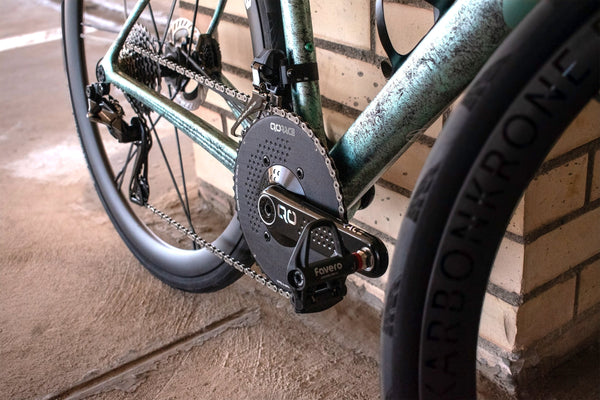
The QO RACE Aero, as a fully aerodynamic double chainring crankset, weighs 624g — less than a Dura-Ace crankset.
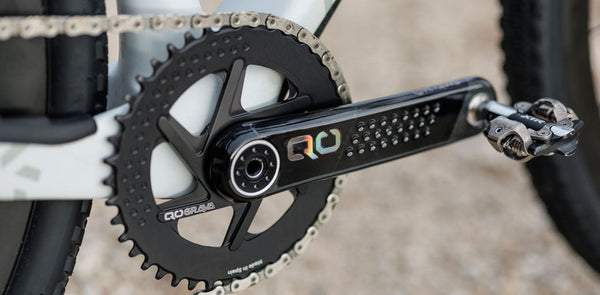
The QO RACE with lightweight spider and chainrings reaches 564g at €599. It goes directly into top-of-the-range territory: just 13g away from SRAM Red. And unlike full groupsets, here you're only changing the cranks — the component that makes most sense to optimise first.
One advantage that doesn't get mentioned enough: if you start with the Aero version, you can later swap the spider and chainrings to gain those 60g without touching anything else. Same crankset, lighter when you want it.
If you're running a mid-range groupset, switching just the cranks saves you 130–226g depending on which version you choose. On the component that rotates more than anything else on your bike.
What changes on the road:
- The lateral stiffness of carbon means the energy you produce goes directly into the chain, not lost to flex
- Response in sprints and accelerations is more immediate
- Reduced rotational mass in chainrings and arms translates into cleaner acceleration
The real decision map
| Upgrade | Typical saving* | Price | Impact |
|---|---|---|---|
| Integrated carbon handlebar | 120–180g | €300–700 | Vibration + weight |
| QO RACE Aero | 85–165g | ~€550 | Drivetrain + response |
| QO RACE (lightweight spider) | 145–226g | €599 | Rotational weight + response |
| Mid-range carbon wheels | 300-400g | €2,000–4,000 | Everything |
*Based on starting groupset (105, Ultegra)
The logic behind the order
If you can invest between €550 and €600, cranks are probably where that budget works hardest. There's no other component at that price that gives you such a significant weight saving in the drivetrain, plus a real improvement in pedalling efficiency. You can also use the opportunity to update your chainring size or crank length to one that better suits your physiology.
Wheels are the ultimate upgrade, but you need to be prepared for the price they demand. Cockpit is a good first step if the budget is tighter.
What is universal: every upgrade should have a clear purpose. It's not about chasing abstract grams. It's about knowing what you want to improve, where the bike is limiting you, and where your money works hardest for you.
QO RACE: built for exactly this
The QO RACE cranks were born from a specific premise: that the crankset is the most critical component on the bike and deserves more attention than it usually gets.
Mitsubishi carbon fibre with a layup optimised for lateral stiffness and vibration control. Chainrings with Smart Shifting Ramps for clean front shifts under load. Full compatibility with Shimano and SRAM 11- and 12-speed groupsets. Available in two configurations: Aero at ~€550 for those who prioritise the aerodynamic spider, and with lightweight spider and chainrings at €599 for those who want the lowest possible weight.
The upgrade too many cyclists have been putting off for too long.
Questions about compatibility with your frame or groupset? Get in touch — we'll help you confirm everything fits before you commit.
Share
Keep reading
Power Up Your QO RACE: Complete Power Meter Guide
The QO RACE crankset was built to perform at the limit: precision-engineered carbon fiber arms,...
A Rider’s Guide to Crank Length
Crank length is a critical but often overlooked factor in cycling performance. It influences cadence,...